
Known as ‘white gold’, lithium is among the most important mined elements on the planet – ideal for the rechargeable batteries used in tech products. Can Europe’s largest deposit bring prosperity to the local community?
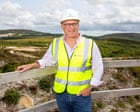
It looks more like the past than the future. A vast chasm scooped out of a scarred landscape, this is a Cornwall the summer holidaymakers don’t see: a former china clay pit near St Austell called Trelavour. I’m standing at the edge of the pit looking down with the man who says his plans for it will help the UK’s transition to renewable energy and bring back year-round jobs and prosperity to a part of the country that badly needs both. “And if I manage to make some money in the process, fantastic,” he says. “Though that is not what it’s about.”
We’ll return to him shortly. But first to the past, when this story begins, about 275-280m years ago. “There was a continental collision at the time,” Frances Wall, professor of applied mineralogy at the Camborne School of Mines at the University of Exeter, explained to me before my visit. This collision caused the bottom of the Earth’s crust to melt, with the molten material rising higher in the crust and forming granite. “There are lots of different types of granite that intrude at different times, more than 10m years or so,” she says. “The rock is made of minerals and, if you’ve got the right composition in the original material and the right conditions, then within those minerals there are some called mica. Some of those micas contain lithium.”
Continue reading…
 Known as ‘white gold’, lithium is among the most important mined elements on the planet – ideal for the rechargeable batteries used in tech products. Can Europe’s largest deposit bring prosperity to the local community?
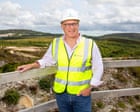
It looks more like the past than the future. A vast chasm scooped out of a scarred landscape, this is a Cornwall the summer holidaymakers don’t see: a former china clay pit near St Austell called Trelavour. I’m standing at the edge of the pit looking down with the man who says his plans for it will help the UK’s transition to renewable energy and bring back year-round jobs and prosperity to a part of the country that badly needs both. “And if I manage to make some money in the process, fantastic,” he says. “Though that is not what it’s about.”
We’ll return to him shortly. But first to the past, when this story begins, about 275-280m years ago. “There was a continental collision at the time,” Frances Wall, professor of applied mineralogy at the Camborne School of Mines at the University of Exeter, explained to me before my visit. This collision caused the bottom of the Earth’s crust to melt, with the molten material rising higher in the crust and forming granite. “There are lots of different types of granite that intrude at different times, more than 10m years or so,” she says. “The rock is made of minerals and, if you’ve got the right composition in the original material and the right conditions, then within those minerals there are some called mica. Some of those micas contain lithium.” Continue reading…Technology | The Guardian